10 Essential Automation Solutions Tips to Boost Your Business Efficiency
In today's fast-paced business environment, adopting effective Automation Solutions has become a necessity rather than a luxury for companies seeking to enhance their operational efficiency. According to industry research conducted by McKinsey, organizations that implement automation can increase productivity by up to 30% in specific functions, leading to significant cost savings and an accelerated time to market. Furthermore, a report from Deloitte highlights that 59% of organizations are already leveraging automation technologies to streamline their processes, indicating a strong trend towards automation across various sectors.
As businesses face increasing pressure to optimize resources while maintaining quality and speed, Automation Solutions provide a strategic advantage. By automating repetitive tasks, companies not only reduce operational errors but also free up valuable time for employees to focus on more strategic initiatives. A recent study by the World Economic Forum points out that automation could lead to a net gain of 58 million new jobs globally by 2022, as human roles evolve to complement enhanced technological capabilities. This shift underscores the importance of integrating automation strategies within business models to boost efficiency and remain competitive in an ever-evolving marketplace.

Understanding Business Automation: Key Concepts and Benefits
Business automation is a transformative approach that involves leveraging technology to execute repetitive tasks, streamline processes, and enhance overall efficiency. By understanding key concepts such as workflow automation and task scheduling, businesses can effectively minimize human error and free up valuable time for employees. Automation tools can range from simple applications that manage routine emails to complex systems that integrate different business functions, allowing for smoother communication and operations.
The benefits of business automation are manifold. Firstly, it significantly reduces operational costs by minimizing the need for manual labor in routine tasks. Additionally, automation increases accuracy, as automated processes are less prone to errors compared to human intervention. Furthermore, businesses that embrace automation can enjoy increased scalability, enabling them to adapt quickly to changing market demands without a proportional increase in resources. Overall, understanding the core principles of business automation can empower organizations to harness its full potential, ultimately leading to enhanced productivity and growth.
10 Essential Automation Solutions Tips to Boost Your Business Efficiency
| Automation Solution |
Key Benefit |
Implementation Cost |
Time Saved per Week |
| Email Marketing Automation |
Improved customer engagement |
$300/month |
5 hours |
| CRM Automation |
Streamlined customer interactions |
$400/month |
10 hours |
| Social Media Automation |
Consistent online presence |
$200/month |
3 hours |
| Content Management Automation |
Enhanced content organization |
$250/month |
4 hours |
| Inventory Management Automation |
Reduced stock discrepancies |
$500/month |
8 hours |
| Sales Process Automation |
Increased conversion rates |
$600/month |
12 hours |
| Project Management Automation |
Better team collaboration |
$350/month |
6 hours |
| Financial Reporting Automation |
Faster data accuracy |
$450/month |
5 hours |
Identifying Areas for Automation: Where to Start in Your Business
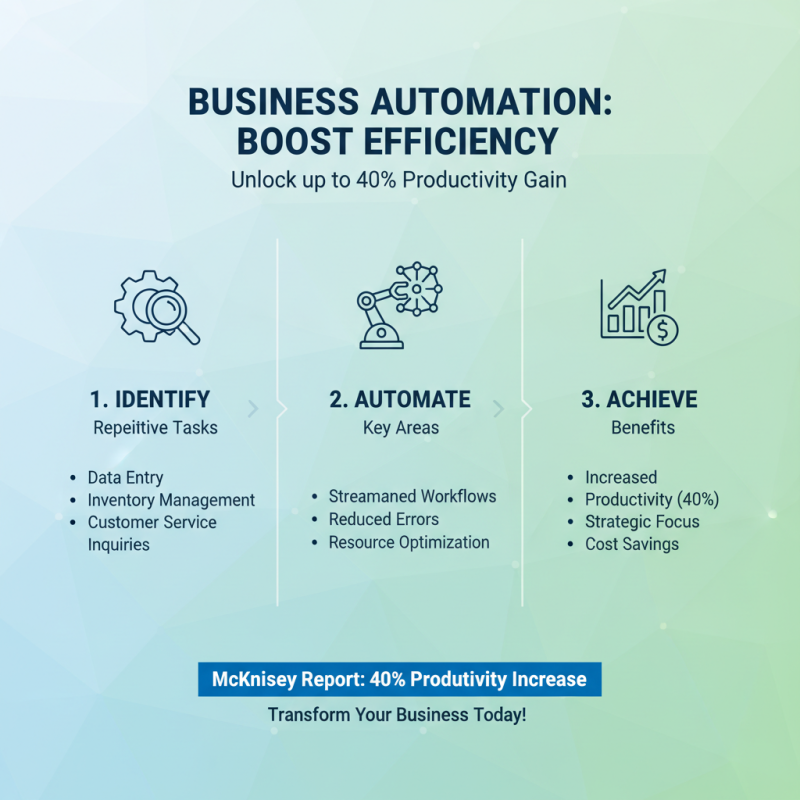
Identifying areas for automation is crucial for enhancing business efficiency. Many companies still rely on manual processes, which can lead to errors and drain resources. According to a McKinsey report, businesses that leverage automation could increase productivity by up to 40%. Start by evaluating repetitive tasks that consume valuable employee time. Areas such as data entry, inventory management, and customer service can benefit significantly from automation, allowing your team to focus on strategic initiatives rather than mundane tasks.
Tip: Conduct a time audit across your operations to identify bottlenecks. Once you have pinpointed areas that require improvement, research automation software that can help streamline these processes. For instance, automating customer inquiries with AI chatbots can not only reduce response times but also improve customer satisfaction, with studies showing that over 70% of consumers prefer chatbot interactions for quick queries.
Furthermore, prioritize tasks based on their impact on your overall efficiency. For example, automating financial processes like invoicing and payroll can save time and reduce the risk of human error. A report by Gartner indicates that automating these tasks can cut processing times by up to 90%. By starting with high-impact areas, you can quickly observe the benefits of automation and inspire further adoption throughout your organization.
Analyzing Industry Data: Impact of Automation on Business Efficiency
In recent years, the impact of automation on business efficiency has been increasingly significant across various industries. According to a report from McKinsey, companies that integrate automation into their operations can enhance productivity by up to 20-30%. This statistic highlights the potential for automation to streamline processes, reduce human error, and allow staff to focus on higher-value tasks. As organizations continue to grapple with the need for efficiency in a competitive landscape, embracing automation becomes not just beneficial, but essential for growth.
 Furthermore, a study conducted by the World Economic Forum indicates that 85 million jobs may be displaced by automation by 2025, but 97 million new roles could emerge, emphasizing the importance of upskilling and adapting to new technologies. By analyzing this data, businesses can better understand that automation does not signify a loss of jobs but rather a shift in the type of expertise required. This evolution encourages organizations to invest in training their workforce, equipping them with the necessary skills to thrive in an automated environment. Ultimately, leveraging automation not only improves operational efficiency but also prepares businesses for a dynamic future.
Choosing the Right Tools: Essential Automation Solutions for Growth
In today's fast-paced business environment, selecting the right automation tools is pivotal for enhancing operational efficiency and driving growth. According to a report by McKinsey, organizations that effectively implement automation can increase productivity by up to 25%, significantly improving their bottom lines. However, the challenge lies in identifying solutions tailored to specific business needs. It is essential to evaluate automation tools that integrate seamlessly with existing systems, streamline workflows, and enhance collaboration among teams.
When considering automation solutions, businesses should analyze their unique processes and objectives. A study from Harvard Business Review highlights that companies that take a strategic approach to automation are 1.5 times more likely to achieve their goals compared to those that adopt a scattered implementation method. Investing in tailored solutions that not only address operational pain points but also allow for scalability can yield significant returns. With the right tools in place, businesses not only improve efficiency but also position themselves for sustained growth in an ever-evolving market landscape.
Measuring Success: Key Metrics to Evaluate Automation Effectiveness
Measuring the success of automation initiatives is crucial for any business looking to enhance efficiency. Key metrics to evaluate automation effectiveness include time savings, error reduction, and cost efficiency. By analyzing these indicators, organizations can gain insights into how automation impacts their workflows and overall productivity. For instance, tracking the time taken to complete tasks before and after implementing automation can reveal significant improvements, allowing businesses to reallocate resources to more strategic activities.
To maximize the benefits of automation, consider implementing these tips. First, ensure your automation solutions are aligned with your business goals. This alignment helps in targeting the right processes for automation, ultimately leading to greater impact. Second, regularly review and analyze data related to automated processes. This not only helps in measuring current effectiveness but also highlights areas for further optimization. Lastly, foster a culture of feedback where employees can share their experiences and suggestions. Encouraging input from those directly involved will help identify challenges and refine automation strategies to better suit team needs.
By focusing on these key metrics and tips, businesses can create a robust framework for evaluating automation's effectiveness, ensuring that it truly enhances efficiency and drives growth.
Key Metrics to Evaluate Automation Effectiveness